A well-fitting bra starts with accurate measurements, but your calculated size is only a starting point. Band fit, cup coverage, straps, underwires and the centre gore can all help you assess whether an individual bra fits as intended.
This Bra Fitting Guide explains how to measure your underbust and fullest bust at home, calculate a starting UK bra size and check the main areas of bra fit. It also covers common fitting problems, sister sizes, when to re-measure and how to compare sizing between lingerie brands.
If you already have your measurements, enter them into our Bra Size Calculator. You can also compare equivalent sizes using the Bra Size Converter or explore illustrated sizes with our Bra Size Visual Comparison Tool.
Start by measuring your underbust and fullest bust to estimate your bra size. When trying on a bra, check that the band sits level, the cups contain the breast tissue without obvious gaping or overflow, the straps sit securely and any underwires follow the breast tissue rather than resting on it. Fit can vary between bra styles, so use your measurements and fitting checks together.
Your underbust measurement is taken around your ribcage directly underneath your bust. This measurement is used to calculate your starting UK band size.
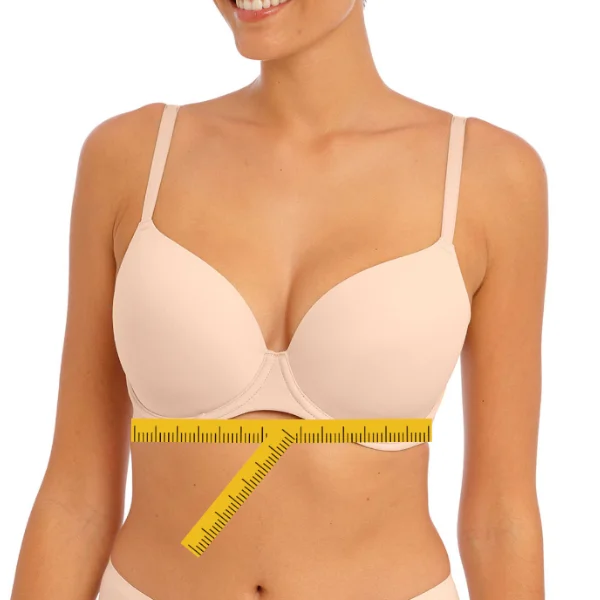
Place a soft measuring tape directly underneath your bust and around your ribcage. Keep the tape level all the way around your body and make sure it is not twisted.
Pull the tape snugly around your ribcage so it sits firmly against the body, while still allowing you to breathe normally. Avoid leaving any slack, then take the measurement in inches and note the nearest whole number.
You will use this underbust measurement together with your fullest bust measurement in our Bra Size Calculator.
Take the measurement two or three times and use a consistent result. If possible, measure while wearing a lightly lined or unpadded bra so bulky padding does not interfere with the tape position.
Your fullest bust measurement is taken around the fullest part of your bust. Together with your underbust measurement, it is used to calculate your starting bra size.
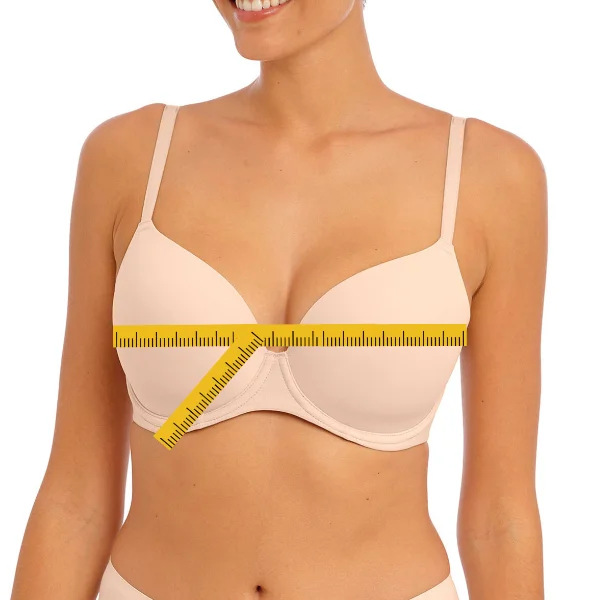
Place the measuring tape around the fullest part of your bust, keeping it level across your back and parallel to the floor.
Let the tape skim the bust lightly without compressing the breast tissue. Record the measurement in inches to the nearest whole number.
Once you have both measurements, enter them into the Bra Size Calculator to estimate your starting UK bra size.
Keep the tape horizontal and check your measurement more than once. Small changes in tape position can affect the result, so consistency is more useful than relying on a single measurement.
Once you have your underbust and fullest bust measurements, use them together to calculate your starting UK bra size. Your underbust measurement is used to calculate the band size, while both measurements are used by the calculator to determine the recommended band-and-cup size.
The quickest way to combine these measurements is with our Bra Size Calculator. Enter both measurements and the calculator will provide a recommended UK band-and-cup size to use as your starting point.
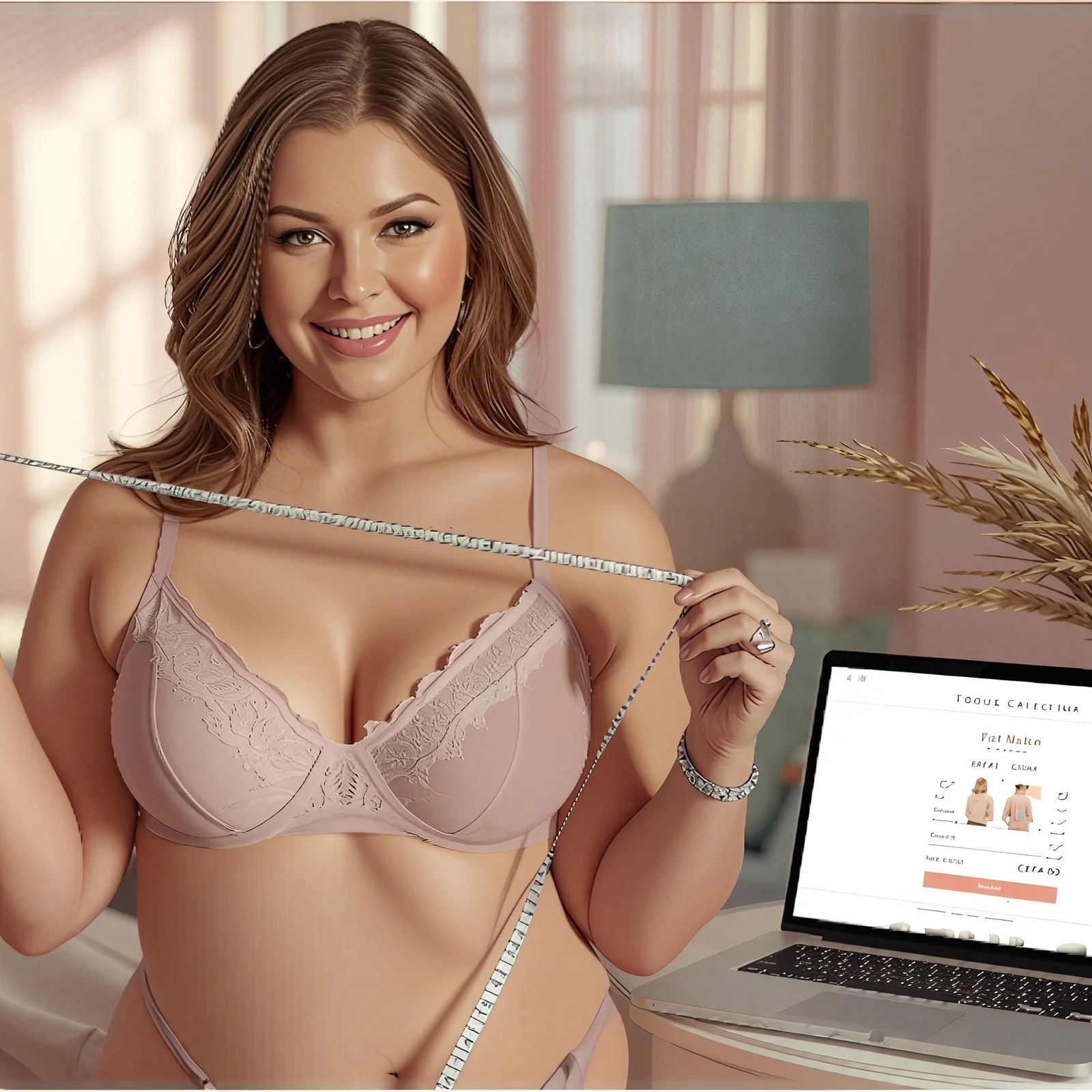
Enter your underbust measurement and fullest bust measurement into the calculator. Keep both measurements in inches and use the same measurements you recorded in the previous steps.
Your calculated size should be treated as a starting point rather than a guarantee that every bra in that size will fit in exactly the same way. Bra construction, cup shape and individual body shape can all affect how a particular style fits.
Measurements help narrow down the size to try first, but the fit of the bra itself is the final check. In the next section, you can use the band, cups, straps, centre gore and underwires to assess how the bra fits when worn.
Once you have a starting size, use this bra fitting guide to check how the bra fits when worn. A good fit depends on several parts of the bra working together, including the band, cups, straps, centre gore and underwires.
The band should sit level around your body rather than riding noticeably higher at the back. It should feel secure enough to stay in place without relying on the shoulder straps for most of the support.
The cups should contain the breast tissue without obvious overflow at the top or sides. Significant gaping or wrinkling can also be a sign that the size or cup shape is not matching your body as intended.
In many underwired bra designs, the centre gore — the panel between the cups — is intended to sit against the chest. Some bra styles are constructed differently, so use the design of the individual bra as part of your fit check.
If the bra has underwires, they should follow around the breast tissue rather than resting directly on it. Check both the centre and outer edges of the wire when assessing the fit.
The straps should sit securely on the shoulders without repeatedly slipping or carrying all of the bra's support. They can be adjusted as needed, but changing the straps should not be used to compensate for a band or cup that is not fitting correctly.
Assess the bra as a whole rather than relying on one sign in isolation. If one area does not look or feel right, compare nearby sizes or a different bra style and check the fit again.
Fit problems can have more than one cause, so it is useful to check the band, cups, straps and overall bra shape together before changing size. The examples below explain some of the most common signs to look for.
A band that rises noticeably at the back may indicate that the band is too loose or that the straps are being used to compensate for insufficient band support. Check the band fit first before adjusting the straps further.
Gaping or wrinkling can indicate that the cup is too large, but it can also happen when the cup shape does not match your breast shape. Compare a nearby cup size and, if needed, a different bra style.
Breast tissue spilling over the top or sides of the cup may indicate that more cup volume or a different cup shape is needed. Check that all breast tissue is sitting inside the cup before assessing the final fit.
Straps that dig into the shoulders may simply need adjustment, but they can also suggest that too much support is being transferred to the straps. Check that the band is providing a secure base before tightening the straps further.
Slipping straps may need to be shortened, but strap position and bra design can also affect how securely they sit on the shoulders. If adjustment does not help, another style may provide a better match.
Underwire resting on breast tissue may indicate that the cup does not provide enough space or that the wire shape is not matching your body. Check both the cup size and the overall bra construction.
In many underwired bras, a centre gore that does not sit against the chest can indicate a cup-size or cup-shape mismatch. However, some bra designs have a lower or softer centre, so always consider the construction of the individual bra.
One fitting symptom does not always point to one specific size change. Compare the full fit of the bra and use nearby sizes or alternative styles where needed rather than relying on a single sign.
If the band or cups do not feel right, you may need to try a nearby size rather than changing only one part of the bra size. Sister sizes are bra sizes with a similar cup volume but a different band size.
For example, if you move down one band size, you usually move up one cup size to keep a similar cup volume. If you move up one band size, you usually move down one cup size.
A UK 34G has a similar cup volume to a 32GG and a 36FF.
Sister sizing can be useful when comparing nearby sizes, but it does not mean that all sister sizes will fit identically. Band tension, cup shape, wire width and overall bra construction can all change how a bra feels when worn.
Use our Bra Sister Size Calculator to find equivalent-volume sizes, or read our Bra Sister Sizes Guide for a more detailed explanation.
Use sister sizes as comparison sizes, not as automatic replacements. Whenever you change the band or cup, re-check the band, cups, straps, centre gore and underwires together.
Bra size can change over time, so it is useful to re-check your measurements whenever your usual bras begin to fit differently or after a noticeable change in your body.
Re-measuring does not necessarily mean your size will have changed, but it gives you an up-to-date starting point before comparing bra sizes or replacing older bras.
Measure your underbust and fullest bust again, then enter the new measurements into our Bra Size Calculator. If the result differs from your usual size, compare both sizes when checking the fit of a new bra.
Measurements are most useful as a current starting point. The final check is always how the individual bra fits when worn.
Once you have a starting UK bra size, you may want to compare how that size appears across different lingerie brands. Brand size charts can vary in the band and cup sizes they offer, so it is useful to check the individual brand guide before ordering.
Use our Bra Size Converter to compare equivalent UK sizes across participating brands, then open the individual brand size guide for the available band and cup range.
You can browse the full collection in our Bra Brand Size Guides directory.
Check the size system shown on the individual product page and use the brand guide alongside your measurements and fit checks. If you are shopping between different sizing systems, compare both the band and cup rather than relying on the cup letter alone.
Use these tools alongside the fitting checks above to measure your starting size, compare nearby sizes and understand how UK bra sizes relate to one another.
Enter your underbust and fullest bust measurements to calculate a recommended starting UK bra size.
Calculate Your Bra Size →Compare equivalent bra sizes across different sizing systems and participating lingerie brands.
Compare Bra Sizes →Find nearby band-and-cup combinations with a similar cup volume to your current size.
Find Sister Sizes →Compare illustrated UK bra sizes side by side to see how band size and cup volume change together.
Compare Sizes Visually →Start with the Bra Size Calculator if you have new measurements. Use the Sister Size Calculator when comparing nearby band-and-cup combinations, the Bra Size Converter when shopping across brands or sizing systems, and the Visual Comparison Tool when you want to compare UK bra sizes visually.
The band should sit level around your body and remain secure during normal movement. If it rides noticeably higher at the back, feels excessively loose or shifts out of position, compare the fit with a nearby band size.
The cups should contain the breast tissue without obvious overflow at the top or sides. Significant gaping or wrinkling may indicate that the cup size or cup shape is not matching your body as intended.
In many underwired bra designs, the centre gore is intended to sit against the chest. Some styles are constructed differently, so check the design of the individual bra as well as the overall fit.
Treat your calculated size as a starting point. Compare nearby band and cup sizes, including appropriate sister sizes, and check whether a different bra shape or construction provides a better match.
There is no fixed timetable that suits everyone. Re-measure when your usual bras begin to fit differently, after noticeable body changes, or whenever you are unsure whether your current size is still the best starting point.
Brands may offer different size ranges and may use different sizing systems depending on the market. Use our Bra Size Converter and individual brand size guides when comparing sizes before ordering.
Measure your underbust and fullest bust, then use our Bra Size Calculator before working through the fitting checks above.
Continue with these guides if you want to compare bra sizes, understand cup progression or find buying guides for your exact UK bra size.
Learn how nearby band-and-cup combinations can have a similar cup volume and when sister sizing may be useful.
Read the Sister Size Guide →Explore the complete UK cup-size progression from AA to LL and learn how cup size changes with band size.
Explore UK Cup Sizes →Browse buying guides for your exact UK band-and-cup size using our bra size directory.
Browse by Bra Size →Explore buying guides for everyday wear, sports, fuller busts and other bra needs.
Browse Buying Guides →Use this bra fitting guide with fresh underbust and fullest bust measurements, calculate your recommended UK bra size and then use the fitting checks above to assess the bra when worn.
Use the Bra Size Calculator, compare sizes with the Bra Size Converter, and return to this Bra Fitting Advice whenever you need to re-check your fit.